 Cultural Association
Celebration speech for the fiftieth anniversary
published
14. August 2026
CULTURAL SOCIETY «HATZIGIORGIS», THEOLOGOS, THASSOS
Address on the Fiftieth Anniversary
Theologos, Thassos, 12 August 2026
Distinguished guests, dear fellow villagers, friends of Theologos,
There are anniversaries one celebrates with words. And there are anniversaries one celebrates with memory. Tonight, let us do the second.
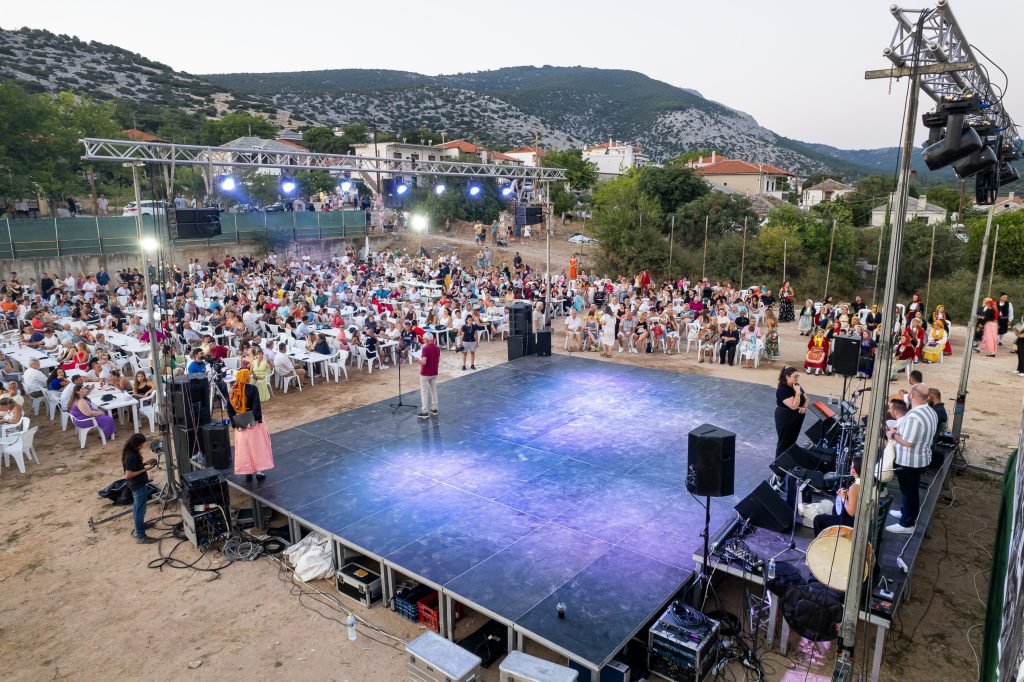
Fifty years. Half a century. A whole village fits inside that number: births and funerals, weddings and departures for foreign lands, winters that never seemed to end, and August evenings like this one.
In 1977, a few people in this village decided to found a society. They had nothing. No office, no funds, no certainty that it would last.
But they had something that cannot be bought: the knowledge that their home deserved more than merely to survive.
It was a time when the villages of Greece were emptying. The children were leaving — for Thessaloniki, for Athens, for Germany. One house closed after another. And into that silence, a few people said: no. We will not let this village wither away.
They did not found a society in order to enjoy themselves. They founded a society so that something would not go out.
Only a few of them are here with us tonight. Let us give them this moment of silence within ourselves — because whatever we may say, they said it first, and they said it without a microphone.
How many people have passed through this society in fifty years? No one ever counted them. And perhaps that is as it should be.
The woman who sewed a costume with her own hands and never asked for her name to be written anywhere.
The man who loaded chairs onto a pickup truck, unloaded them, and then loaded them again at midnight, when everyone else had gone.
The dance teacher who waited out in the cold in case the rest of the children might still come.
The old man who sat down in front of a tape recorder and said everything he remembered, so that it would not leave with him. The mothers who baked, the fathers who painted, the children who carried, and those who had emigrated and sent what they could from far away, with a note attached: «for the village».
These people almost never appeared in a photograph. They never climbed onto a stage. They never asked for anything.
And yet they are the society. Not the statutes. Not the seal. They are.
It would be impossible to fit the whole course of these fifty years into this evening. But let us recall a few things, in order to remember all the rest.
The Folklore Museum, inside the mansion of 1813 — a house that could have been torn down and instead became memory. The playground. The equipment for the rural clinic, which is sometimes measured in lives. The blood donation group, which began quietly and was honoured in 2005 by the Hospital of Kavala. The lending library. The magazine «Koufokastro». The signposting of the village, the clean-up campaigns, the lectures by university scholars on the natural environment and the aquifers of our region, the clearing and opening up of the waterfalls, the restoration of the historic footpath: the dry-stone terraces, the wooden bridge, the arch of the old watermill on the road to Kefalogourna. The Cultural Centre of Theologos, the bust of Hatzigiorgis, and more besides. And much that was never seen. It was written up in no newspaper. It drew no applause. But it was done. And it belongs to us just the same.
And our dance group, which holds a thread that begins in 1960 — with the Ladies’ and Young Women’s Association, with the first prize for traditional costume at the Dora Stratou festival, with the first recordings of Thassian songs made with Simon Karas. Fifty, sixty years later, those same songs are heard tonight from children’s mouths. That is not a custom. That is a victory.
Allow me, on an evening such as this, to say something that is not easy to say at a celebration.
We love our festivals. We love them truly. They are among the finest things the Greek village has: the smells, the tables, the old men and women who rise to dance and are suddenly twenty years old again. Without them we would be poorer.
But let us say it plainly, once, tonight, while we are all together:
The festival is not the culture. It is the celebration of culture. It is the wreath, not the root.
The question is not how many people came. The question is what remained the next day.
Culture is what remains when the lights go out and the tables are cleared away.
It is the footpath that was cleared and that will be walked by children not yet born.
It is the stone fountain that was not left to fall into ruin.
It is the abandoned school that found its voice again.
It is the local product that acquired a name and a value.
It is the history of the village, recorded just before it departed along with the last people who remembered it.
And above all, it is a child who has learned to love this place — not because we told them to, but because they lived it.
Perhaps, then, the time has come to say again, from the beginning, what «cultural society» actually means.
A real cultural society does not wait for a grant in order to act. It creates. It cooperates. It envisions. And when it must, it makes demands.
It is a workshop of ideas and of voluntary effort. It is a voice for the environment. It is a school for the children where the school itself cannot reach. It is the conscience of its own place.
For culture is not the applause of a single evening. It is the inheritance we leave behind.
All of us are called to answer «present» — one with a little, another with more, each according to their strength and their willingness. No one owes more than they are able to give.
Perhaps, indeed, more could have been done, had more people given more.
But that is not a question for others. It is a question each of us must put, silently, to ourselves:
«What have I done?»
And the answer we owe neither to the society nor to the village. We owe it first of all to ourselves.
My dear friends,
Fifty years ago, some people lit a small light in this village. They did not ask us to admire it. They handed it to us so that we would keep it burning.
To those who have gone: thank you. The village remembers you.
To those who are still holding on: strength to you. We know what it costs.
And to you, the children listening to us tonight — the next fifty years belong to you. Do not wait for others to bring them.
Many more years to the «Hatzigiorgis».
Many more years to Theologos.
Thank you.
The President, Giannis Karantelos